
Higher rates are squeezing household budgets, property prices are sliding, and offset accounts are under scrutiny. Here are four stories worth knowing about right now:
- The hidden offset problem costing borrowers millions
- Cheaper homes are bucking the property downturn
- Housing rules blamed for holding back new supply
- Five ways to pay off your mortgage sooner

An offset account should reduce your interest bill automatically – but a new ASIC review shows that’s not something borrowers should simply take for granted.
ASIC, the financial services regulator, reviewed eight banks representing more than 70% of Australia’s home loan market and found weaknesses in how all eight set up, monitored and managed offset accounts.
Between September 2023 and August 2025, banks paid more than $55 million in compensation for offset failures, with further compensation expected.

The problem can be hard to spot
When an offset isn’t working correctly, your repayments may not change.
Instead, more of each repayment can go towards interest and less towards reducing your principal – potentially leaving you worse off without realising it.
That’s why it’s worth checking that your offset is properly linked to your loan and that you’re receiving the interest savings you expect.
If you’re unsure how your offset should be working, your mortgage broker can help you understand your loan structure and what to check with your lender.

Falling prices are changing the balance between buyers and sellers – but the slowdown isn’t affecting every property equally.
Australia’s median property price fell 0.7% in July, the largest monthly decline since December 2022, according to Cotality.
Prices were down 1.9% over the July quarter.
But there’s an interesting divide underneath those headline numbers.
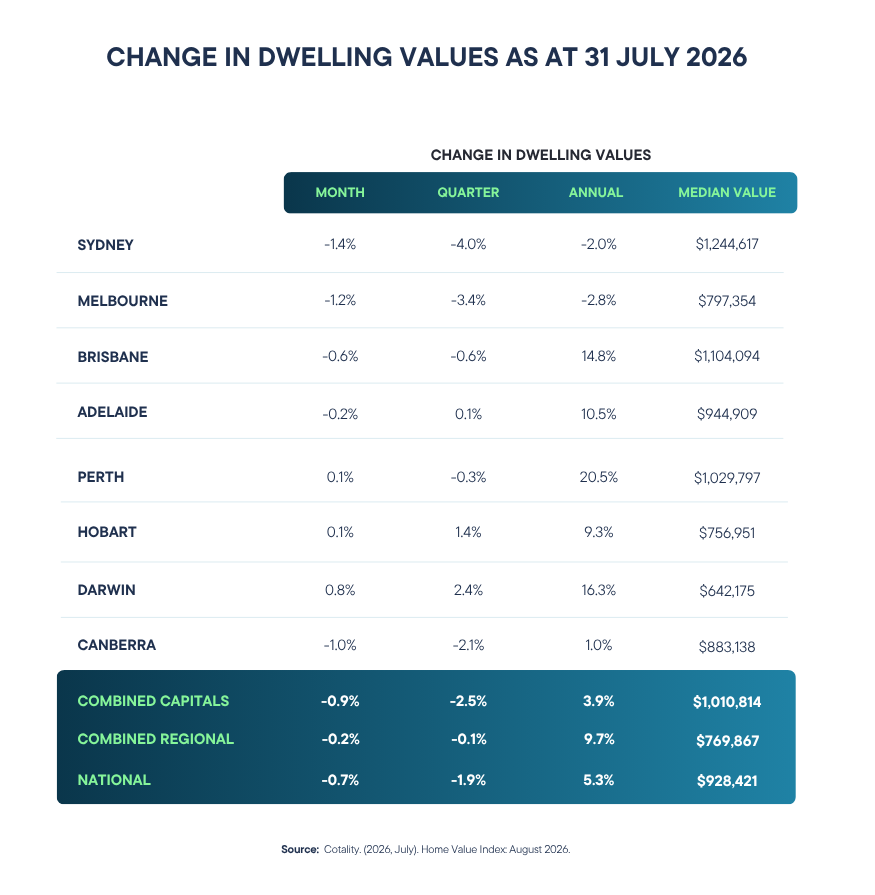
Expensive homes are falling faster
Over the three months to July:
- Upper-quartile home values fell 3.2%.
- Lower-quartile values actually rose 0.3%.
Buyers remain constrained by affordability, mortgage serviceability and cost-of-living pressures, while confidence is weaker than earlier in the year.
Sellers have taken longer to adjust, although Cotality says expectations are now beginning to shift.
For buyers, softer conditions may create more negotiating room – particularly at the higher end.
For sellers, realistic pricing may become increasingly important.
Knowing your borrowing ceiling before you negotiate can be especially valuable in a shifting market. Get in touch with an experienced mortgage broker to better understand yournumbers.

Building more homes could help ease Australia’s affordability pressures – but the Productivity Commission says regulation is standing in the way.
The Commission’s interim report says poorly designed regulation can make new housing slower and more expensive to build, while reducing the types of homes available.
It argues that relaxing land-use controls is one of the most important steps governments could take to increase supply.
Potential reforms include allowing three-storey developments on most residential land, reducing minimum lot sizes and permitting more apartments in high-demand locations.
Faster approvals could also help
The Commission found that complex approval processes can add months or even years to projects.
Its proposed approach includes simpler regulation and better coordination between housing and infrastructure.
More supply won’t solve affordability overnight, but making it easier to build homes in desirable locations could give buyers more choice over time.
Building loans work differently
Construction finance differs from a standard home loan, with funds generally released as building work progresses. Before signing a building contract, it’s worth understanding your borrowing capacity, expected repayments and financial buffer.
If you’re planning a new build, getting in touch with a mortgage broker can help you understand how much you could borrow and how construction finance may work for your project.

Paying off your mortgage years early can save substantial interest – although finding extra money isn’t easy in today’s environment.
Elevated interest rates and cost-of-living pressures mean many households are already watching every dollar.
That can make large extra repayments unrealistic, but smaller changes to how you manage your mortgage can still help you get ahead over time.
Small moves can add up
Potentially, you could:
- Consider paying half your monthly repayment every fortnight. Depending on how your lender calculates repayments, this may result in the equivalent of an extra monthly repayment each year.
- Use your offset strategically. Keeping spare cash there can reduce the balance on which interest is calculated.
- Put windfalls towards the loan. Tax refunds, bonuses or other unexpected money can chip away at principal.
- Keep repayments higher if rates fall. The extra amount can accelerate your progress.
- Review your interest rate. A lower rate may free up money that can be redirected towards your mortgage.
Before making extra repayments, check your loan’s conditions and maintain an appropriate cash buffer.
Want to get ahead on your mortgage? Get in touch, and we can look at whether your rate, loan features or repayment setup could help you make faster progress.
The housing market may be changing, but good preparation never goes out of style. Whether you’re buying, building, or paying off your mortgage, reach out to Goodwill Finance, and we will help you make sure you’re well positioned. You can contact us by emailing us at [email protected] or by calling us at 0423 459 480.
Disclaimer: The information provided is of a general nature and does not take into account your personal financial circumstances, goals, or needs. It should not be considered financial or investment advice, nor a recommendation or invitation to acquire financial products or services. You should not act solely on this information without obtaining professional financial advice tailored to your situation. Any loan application is subject to a full assessment of your financial position, as well as the lender’s terms, conditions, fees, charges, and eligibility criteria.